Look Up: The Importance of High Dusting in Warehouses
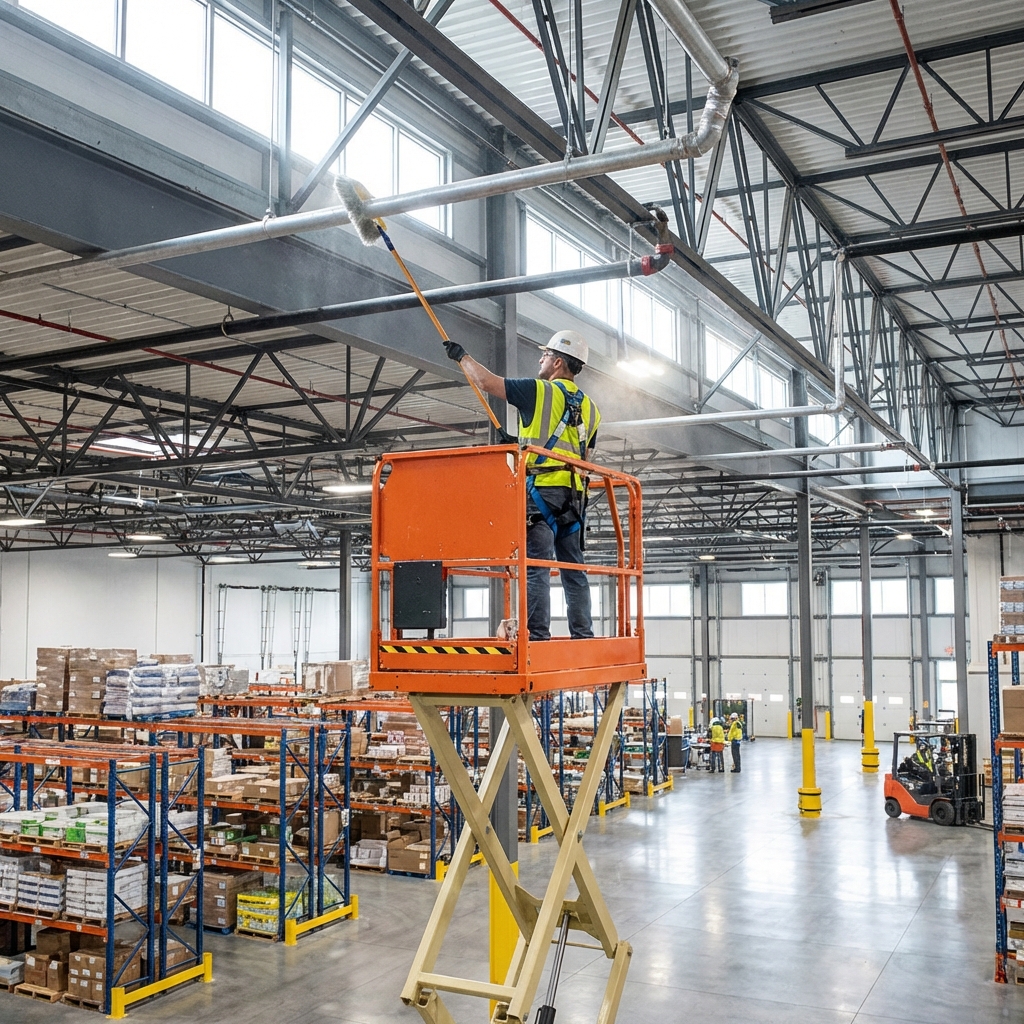
In the world of industrial facility management, what you can't see can definitely hurt you. While most warehouse cleaning schedules focus on eye-level cleanliness—floors, racks, and loading docks—a silent threat accumulates overhead. High dusting, the process of cleaning rafters, pipes, ductwork, and lighting fixtures above regular reach (typically 10-30 feet high), is often the most neglected aspect of industrial maintenance. Yet, ignoring it poses severe risks to safety, compliance, and product integrity.
The Hidden Dangers of Overhead Dust
Dust doesn't just sit there; it evolves into a hazard. In a warehouse environment, "dust" is a complex mixture of cardboard fibers, wooden pallet splinters, soil, and whatever chemical particulate is relevant to your inventory. When this mixture collects on high surfaces, it creates several critical problems:
1. Fire and Explosion Hazards (Combustible Dust)
The most immediate danger is fire. Many types of dust are combustible. When accumulated on high surface areas (like beams), a small disturbance can shake this dust loose, creating a suspended cloud. If this cloud meets an ignition source (a spark from a forklift, a hot light fixture, or static electricity), it can cause a deflagration or explosion.
Even if the dust isn't explosive, thick layers of fluff act as kindling. Fire spreads rapidly across the ceiling trusses, bypassing ground-level suppression systems until it's too late. The NFPA (National Fire Protection Association) has strict standards regarding combustible dust accumulation (often defined as anything thicker than a paperclip, or 1/32 of an inch).
2. Product Contamination and Quality Control
Gravity is undefeated. Vibrations from facility operations—forklifts banging into racks, HVAC systems cycling on and off, or even heavy trucks passing outside—cause high-level dust to rain down continuously.
For distribution centers, especially those handling food, pharmaceuticals, or electronics, this "dust rain" is a disaster. It coats inventory, ruining packaging and potentially contaminating the product inside. A rejected shipment due to contamination can cost thousands of dollars and damage client trust permanently.
3. HVAC Efficiency and Air Quality
Your building's intake vents are often located near the ceiling. When dust accumulates around these intakes, it clogs filters faster than expected and restricts airflow. This forces your HVAC system to work overtime to maintain temperature, driving up energy costs.
Furthermore, this dust is constantly recirculated into the breathing air. Employees on the floor inhale these particulates, leading to respiratory issues, allergies, and "Sick Building Syndrome." Improving air quality isn't just about filters; it's about removing the source.
The High Dusting Process: Safety First
Cleaning at heights is inherently dangerous. It is not a job for your regular janitorial staff or a warehouse associate with a ladder. It requires specialized certification and equipment.
Essential Equipment
- Scissor Lifts and Boom Lifts: To reach 20+ foot ceilings safely. Operators must be certified (e.g., in Ontario, they need "Working at Heights" and lift operation safety training).
- HEPA Vacuums: We never just sweep dust off a beam; that simply moves the problem to the floor (and the air). We use industrial vacuums with High-Efficiency Particulate Air (HEPA) filters to capture 99.97% of dust at the source.
- Extension Wands and Brushes: Specialized camera-equipped carbon fiber poles allow technicians to clean and inspect tops of pipes and tricky angles from the lift basket.
- Degreasing Agents: In manufacturing environments, dust often mixes with oil mist to form a sticky sludge. This requires chemical scrubbing, not just dry vacuuming.
Regulatory Compliance (The "Why" for Auditors)
If your facility undergoes third-party audits (like AIB, SQF, BRC, or FDA inspections), high dusting is a major compliance point. Auditors always look up. Visible webs or dust trails on overheard pipes are an immediate "minor" or "major" non-conformance.
Regular high dusting ensures you are always audit-ready. We provide photo documentation (Before & After) and completion certificates to keep on file for your next health and safety inspection.
Frequency: How Often is Enough?
The frequency of high dusting depends on your specific operation:
- Food/Pharma Storage: Quarterly or Semi-Annually. Zero tolerance for visible contamination.
- General Warehousing: Annually. A "Spring Clean" of the rafters prevents unmanageable buildup.
- Manufacturing (Paper/Wood/Textiles): Monthly or Quarterly. These industries generate massive amounts of dust that creates fire hazards quickly.
What Does a High Dusting Service Cover?
A comprehensive scope of work should typically include:
- Ceiling Trusses and Bar Joists: The structural skeleton of the roof.
- Lighting Fixtures: Cleaning the lens covers improves lumens (light levels) on the floor, making the warehouse brighter and safer.
- HVAC Ducting and Diffusers: Cleaning the exterior surfaces.
- Sprinkler Pipes: Crucial Caution: Sprinkler heads are incredibly fragile. A professional knows never to touch the bulb itself, but to carefully clean the pipework around it.
- Conduit and Cabling: Topside of electrical trays.
- Walls and Columns: High ledges and window sills.
Protecting Your Operations During Cleaning
Facility Managers often worry that cleaning will disrupt operations or dirty the stock. We mitigate this through:
- Tarping: We cover racks and inventory with plastic sheeting before work begins in a zone.
- Off-Hours Scheduling: We work evenings or weekends when the forklifts are parked.
- Zoned Cleaning: We tackle the facility aisle by aisle, allowing you to keep the rest of the warehouse active.
Conclusion: Look Up and Clean Up
A clean ceiling means a clean floor and a safe product. Don't let overhead neglect undermine your ground-level efficiency. High dusting is an investment in risk management.
By proactively scheduling this maintenance, you avoid the panic of a failed audit or the tragedy of a workplace accident. It demonstrates to your staff and your customers that you care about every square inch of your facility—even the parts they look up to see.
Frequently Asked Questions High Dusting
Q: Will you need to shut down my facility?
A: Rarely. We typically work nights or weekends to ensure zero disruption. If we must work during the day, we cordon off specific aisles.
Q: How do you protect the stock below?
A: We use large, heavy-duty tarps to cover all racks and machinery. We also use vacuums attached to our cleaning tools to capture dust before it falls.
Q: Is this a one-time service?
A: While some clients treat it as such, we recommend an annual program to prevent the buildup from becoming a fire hazard again. Regular maintenance is always cheaper than emergency remediation.
Q: What about my lighting?
A: We clean the fixtures as we go. You will likely notice a significant increase in brightness on the floor immediately after we finish, often reducing the need for auxiliary lighting.
Is your warehouse ceiling looking fuzzy? Contact Clearo today for a site assessment. We will bring the lift, the safety gear, and the experience to get the job done right, safely, and cleanly.